

Finland suffered a heavy 4-0 defeat in the crucial World Cup qualifying game against Ronald Koeman‘s Netherlands, with goals from Donyell Malen, Virgil van Dijk, Memphis Depay and Cody Gakpo.
Finland played without their longstanding captain Lukas Hradecky, Wembley hero Arttu Hoskonen and Teemu Pukki was on the bench. This starting lineup was controversial as it did not have a recognised centre forward – Benjamin Källman and Joel Pohjanpalo were named substitutes, with Leo Walta playing in a midfield 3 with Kaan Kairinen and Santeri Väänänen, with Topi Keskinen and Oliver Antman as the front 2. The idea of using Keskinen‘s speed indicated that Finland wanted to defend deep, with Källman, Pukki and Pohjanpalo as medium-distance options – yet Källman could have held the ball up better and provided a goal threat in the box. There were other surprising omissions – Matti Peltola was on the bench behind Ville Koski with right wingback Adam Ståhl playing as the right-sided centre-back, the more experienced Jere Uronen was overlooked for the exciting but inexperienced Juho Lähteenmäki. A correct selection call was made to put Robin Lod on the bench as he seemed to lack energy when substituted on.

First half blowout
Finland was completely outplayed in the first half, with the Netherlands’ ball speed being too quick for the Finnish players. The problems started very early on with Finland’s block. Finland’s outside midfielder formed a slightly diagonal line with the centre forward – this was appropriate when the midfielder presses the direct opponent with back-to-goal, however in a 5-3-2 system, this opponent would usually be a midfielder in the half-space who can receive the ball and play forward. As a result, Finnish midfielders had to cover massive distances and could not close down the Dutch players.

Such was the poor positioning and press of the outside midfielder that the Dutch were able to play around and through the Finnish block.
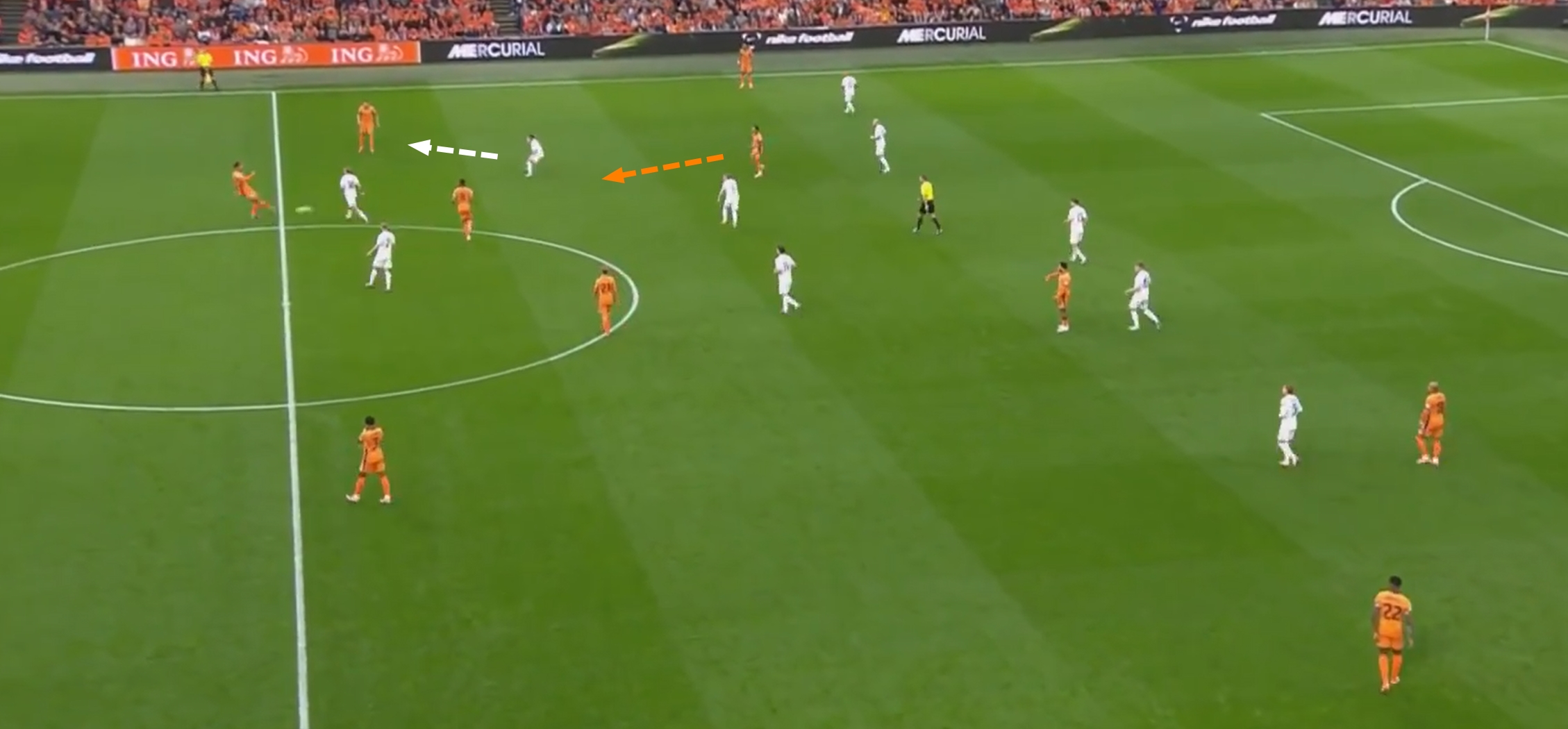

Finland’s man-to-man pressing at the front yielded some results, as pressing the Dutch goalkeeper Bart Varbruggen resulted in him booting the ball out of play to the out-of-position left-back Micky van de Ven on one occasion. However, the behaviour of the pressing was concerning when a teammate up the field was dribbled past, as the closest player would essentially leave their direct opponent to press the ball carrier.
In the example below, Leo Walta went to press and Ryan Gravenberch simply moved out of the pressing shadow to receive the ball.

In another example, Juho Lähteenmäki left his opponent to press on the wing, only for an outside-inside-outside passing pattern to beat a wingback who had pressed too high up.
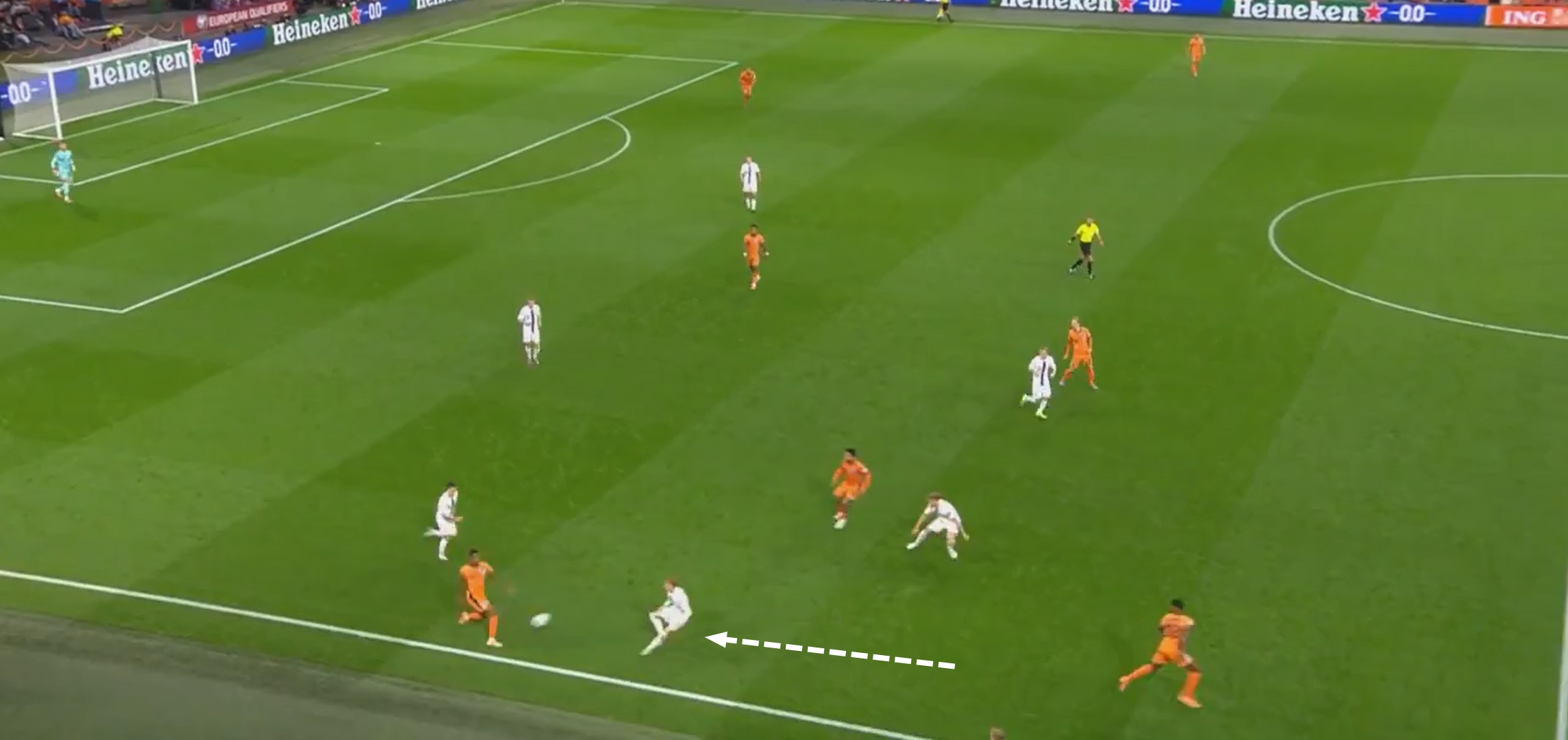
With left centre-back Ville Koski dragged away by Donyell Malen, the rest of the Finnish backline were in no position to defend this 25-metre Denzel Dumfries run on the near side.

The Finnish backline did very well not to have two centre-backs stepping out simultaneously against the Dutch attack. Against this dummy by the Italy-bound Donyell Malen, centre back Miro Tenho made the right choice not to step up and close down Memphis Depay.

In this example, goalkeeper Bart Varbruggen played through the Finland block to Justin Kluivert who had dropped deep into space to receive against the unfamiliar right centre-back Adam Ståhl. Again, Miro Tenho made the right choice not to step up against midfielder Ryan Gravenberch, the Finnish midfielders frantically retreated and pressed the Liverpool midfielder. Gravenberch actually did not carry the ball forward as he would for Liverpool, instead he switched the ball to the right-hand side.

The Finnish defenders were compact and valiantly defended in their own box but the Netherlands players showed bags of tricks that earned them clear heading opportunities. Inter Milan full-back Denzel Dumfries made a run between Ville Koski and Juho Lähteenmäki to get a close header on goal, while Donyell Malen also managed to get in front of Ville Koski for a high xG header.

For the opening goal, the unplayable Donyell Malen played a one-two past Leo Walta and fired the shot past Jesse Joronen who got a hand to the shot but could not keep the ball out.

Netherlands’ set piece brilliance
The Dutch were the team to watch out for in set pieces. For the 2nd goal, Virgil van Dijk beat the undersized Juho Lähteenmäki in the air near the back post from a good inswinger by Memphis Depay to score from close range.

It wasn’t just the threats they possessed – van Dijk, Van de Ven, Dumfries, Gakpo, Timber, Malen (Nathan Ake and Wout Weghorst on the bench), it was the confidence in delivering short corner routines and 2nd phase of set pieces. Other than the obvious example of Virgil van Dijk at the back winning the initial header against Juho Lähteenmäki, in the following example, we see that the Dutch played a short corner routine and got their mismatches at the back post: Dumfries vs Lähteenmäki, Timber vs Kairinen, van Dijk vs Väänänen, with Timber heading against the crossbar and van Dijk’s volley blocked by brave Finnish players.

Before the third goal, the Dutch short corner routine option Justin Kluivert drifted to the top of the 18- yard box. As the short corner played out, he became another player that the Finnish players needed to defend. It was his shot that was unfairly blocked by Miro Tenho that resulted in the penalty kick.

For the penalty kick, Memphis Depay’s unusually wide angle of the run-up indicated that the ball was going straight. His pause in the run-up was enough to throw Jesse Joronen off and made the keeper go the wrong way.
Better attack under Jacob Friis
The Dutch rushed the Finnish goalkeeper Jesse Joronen during transitions and some of the build up, forcing long balls to attackers Topi Keskinen and Oliver Antman who were not centre forwards that could win the long ball.
Finland played comfortably in the middle third. There was a moment when the Finns played through the Dutch block, with de Jong asking questions of where the defending Dutch players were.

On the flanks, the Finns attempted to attack the channels by prompting the Dutch full-back to press the Finnish wingback. This was a regular pattern that saw some success as the Dutch limited the space and angle of the passes well.

The Dutch were also not immune to overloads in the backline, with Finnish attackers running in the gaps and coming close to getting through on goal, 1v1 with the Dutch keeper.

The Finnish players struggled to create in the final third. At times, there was too much overload on the ball side, with very few attackers in the middle for the cross. There was also an interplay pattern – outside inside outside with the third man running into the channels – but even if that worked out, the 2v2 in the middle involved a non-centre forward and a wingback who was positioned too deep for the incoming cross.
 Outside-inside-outside pattern with 3rd man running into channel
Similar to the previous manager Markku Kanerva, Finland’s chances came through the counterattack and set pieces. Pressing the Dutch midfielder inside the 3-2 midfielder attacker zone, the Finns were able to turn the ball over, using Oliver Antman, the speed of Topi Keskinen and a third supporting player to receive the ball behind the Dutch midfielders and run forward for the counterattack. They found more joy attacking Timber on the left than the delaying van Dijk.


In the set piece situation, Finland’s greatest aerial threat for the match, Miro Tenho, had a great chance to head the ball in the 6-yard-box. With Dutch players in the first line not marking their opponent and the 2nd line of zonal markers positioned low in the 6-yard-box, Finnish players starting from 12 yards out could run to the top of the 6-yard-box unopposed.

2nd half changes
The Netherlands took the foot off the gas pedal and the Finns made changes that had mixed results.
There was a much better and coordinated press on the Dutch right centre back Timber, whose wide positioning would force him play a vertical ball down the line to be intercepted.

However, Finland’s group of 5 midfielders and attackers became even closer together and it looked as though the backline and the front group became two separate units as there were large spaces between them.

As a result, this has put huge emphasis on the outside centre backs in how they defend these spaces. The diamond shape worked well in stopping the attacks down the right hand side.

On the left hand side, both Juho Lähteenmäki and Ville Koski stepped up. This created a potential third-man combination for the Dutch as shown below.

The way the Finnish backline ran offside was of some concern. In the following example, after Ville Koski decided to follow his attacker into midfield amidst marking and communication issues with the midfielder, Miro Tenho decided to step up and Adam Ståhl reacted to step up at the same time, leaving right wing back Nikolai Alho the last person in the long backline to react and step up.

The Dutch identified this area of the backline as a way to break through. This time, with de Jong having time and space on the ball and being able to play a longer ball from under his feet, the backline stood there for the through ball to be played, only for Malen to be marginally offside.
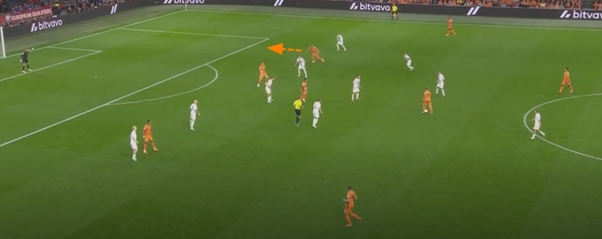
The Finnish defence limited the Dutch to fewer chances in the 2nd half, but one little tactical instruction allowed Cody Gakpo to score. The defensive midfielder, Kaan Kairinen was instructed to cut the ball to the feet of the Dutch attackers when the ball is wide. However, in situations where Dutch attackers cut in, his role was to stop the shot of any opponent in his zone. Tijjani Reijnders fired a warning shot early in the 2nd half, before Gakpo scored the 4th goal of the game.

Substitutions made a difference
The Dutch substitutions Nathan Aké, Tijjani Reijnders and Jan Paul van Hecke improved positional play, Xavi Simons operated in the pockets to provide another dimension at attacking midfield, while Wout Weghorst played on Miro Tenho – a slight miscalculation as playing on Ville Koski and Juho Lähteenmäki or the out-of-position Adam Ståhl in crossing situations would have caused even more trouble for the Finnish defence.
 Weghorst and Simons combined to win a free kick just outside the box
The Finnish substitutions allowed them to be more dangerous in attack. A 5v4 in the backline with wingbacks overloading saw right wingback Matti Peltola in space against the left winger / centre forward Cody Gakpo.

The centre forward pairing of Benjamin Källman and Joel Pohjanpalo allowed the Finns to have more threats in the box. This counterattack saw van Hacke tracking his man and van Dijk retreating in a straight line in depth defending, allowing Källman a snap shot on goal.

Conclusion:
Against a world-class team in the Netherlands, it showed that the Finnish team needed more players who played in the top 5 leagues to cope with the ball speed and intensity of the game. The 5-3-2 system was appropriate for the composition of the squad, however the defensive frailties were exploited by the Dutch. The attacking side of the game was more fluent under Jacob Friis as Finland looked to find another Teemu Pukki.
The Netherlands qualified for the World Cup with a squad led by Virgil van Dijk, Frenkie de Jong, Cody Gakpo and at times the unplayable Donyell Malen. The attacking set pieces were a highlight for them. The performance was by no means perfect but they still had months to prepare for this big tournament.
The player who stood out in the match:
Frenkie de Jong, Netherlands / Barcelona, 1997
Despite not getting on the scoresheet, he kept the Netherlands ticking with 112/118 passes at 95% success rate. His ability to maintain possession was very strong and one of his best traits was his ability to play long passes with the ball under his feet. To limit his influence, the compact Finnish group of 3 midfielders and two forwards putting De Jong under pressure forced him to slow down or misplace passes. He was energetic in group defending with 3 tackles and 6 recoveries, however he could give away the ball in aerial duels and could be dribbled past in open space. Against a stronger opposition, discussion would arise on which player should partner with de Jong to solidify the midfield.
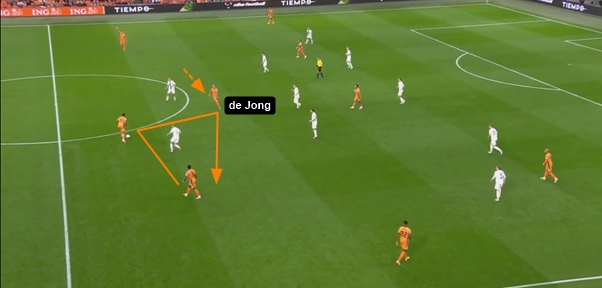 De Jong’s brilliant possession play
You can check our offers here and reach out to us via our ‘Contact us’ page for fixed or flexible packages. If you like it please SUBSCRIBE to the blog and you will receive all future articles and news.
