

Transitions, Tempo and Territory: Bologna vs Brann (1-0, aggregate score: 2-0).

Stadio Renato Dall’Ara (Bologna, Italy) — 26 February, 2026 — Bologna FC 1909 vs SK Brann 1-0 (aggr. 2-0)
SK Brann, led by Icelandic coach Freyr Alexandersson, played in 4-3-3 formation.
The match opened at a high tempo from both sides, with intensity in transitions and direct intent early on. However, Brann managed to create the more dangerous situations in the opening phase despite neither team applying an aggressive high press. The defensive lines were relatively compact, allowing build-up phases to develop without constant pressure.
Brann involved their goalkeeper consistently as an active part of the build-up, almost functioning as an additional outfield player to circulate possession and initiate progression from the back. Their approach combined structured build-up with frequent long balls, while also attempting quick central combinations, although many of these central sequences were disrupted by Bologna’s well timed pressing traps.
A recurring issue for Brann was their defensive reaction during Bologna’s transition attacks. On multiple occasions, they struggled to match the pace of counter movements, leaving attackers unmarked in dangerous zones.
The lack of compactness during defensive recovery ultimately proved costly, particularly when the game opened up in the second half.
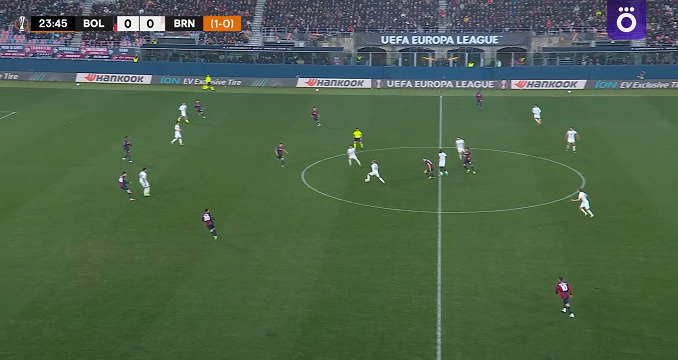
Bologna FC 1909, led by Italian coach Vincenzo Italiano, opted for 4-3-3 formation.
Bologna’s attacking plan leaned heavily on direct play and left sided progression, utilizing the pace of Jonathan Rowe to stretch Brann’s defensive structure. Long balls and switches toward the left flank were a recurring pattern, aiming to isolate defenders in wide areas.
At the start of the second half, Bologna noticeably increased the tempo. Much of their offensive rhythm came through the right flank, where João Mário (player on loan from Juventus FC) became more influential in advancing play and creating momentum. This shift led to several promising moments before the breakthrough arrived in the 56th minute.
The goal originated from intelligent movement on the wing by Rowe (see image below).

Players who stood out in this match:
Jonathan Rowe (Bologna FC 1909), left winger born 2003
Rowe was one of the most decisive profiles on the pitch — not just because of the goal sequence he initiated, but because of the constant tension he created in Brann’s defensive structure.
His quick feet and tight control allowed him to attack defenders in isolation situations, especially in wide areas. In 1v1 moments, he showcased confidence and variety in his dribbling, also capable of accelerating past his marker or cutting inside to destabilize the defensive line.
What stood out most was his tempo of play. Rowe operates at high speed consistently, whether carrying the ball forward or attacking space off it. He doesn’t slow sequences down, he increases their intensity. That rhythm shift was particularly visible in the second half when Bologna raised their overall pace.
His movement without the ball was equally important. He constantly adjusted his positioning to exploit gaps during transitions, timing his runs well between full-back and centre-back. The 56th-minute goal sequence began from one of these intelligent wide movements, where he attacked space dynamically and forced defensive imbalance.
Scout note
A direct, high tempo winger who thrives in transition heavy matches. Rowe combines technical sharpness with vertical intent and active off-ball intelligence, a profile that fits well in systems that prioritize speed, width, and quick attacking phases.
Nana Kwame Boakye (SK Brann), centre-back born 2005
Boakye delivered a composed and mature defensive performance, showcasing qualities that stand out particularly given his young age.
His positioning was one of the key strengths throughout the match. He read attacking movements early, adjusted his body orientation well, and consistently placed himself in zones that allowed him to intervene without overcommitting. This anticipation reduced the need for last ditch defending.
In moments of pressure, especially during transition phases, he remained calm and efficient. His clearances were decisive and purposeful, avoiding unnecessary risks while relieving pressure effectively.
What impressed most was his decision-making under pressure. Whether stepping out to close space or holding his line, Boakye demonstrated strong judgment. He rarely forced actions and instead chose solutions that maintained defensive structure.
Scout note
A defensively intelligent profile with natural composure. Strong positional awareness, clean interventions, and mature choices under pressure suggest a centre-back with solid developmental foundations and high tactical understanding.
