

Intensity, Quality and Promising Individual Performances
Tromsø started the game in a 3-4-3 formation, looking to apply aggressive pressure against KFUM’s defensive line from the opening minutes. Their pressing approach aimed to disrupt KFUM’s build-up and force them into quicker decisions when playing out from the back. When possession was turned over, Tromsø looked particularly dangerous in quick transitions.
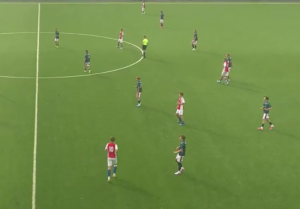
Tromsø opened the scoring in the 7th minute. A long ball played against the direction of play cut through the KFUM defensive line and found Henriksen Labukt. He capitalised on a poor decision from the goalkeeper, who came off his line unsuccessfully, allowing Labukt to finish and put Tromsø 1–0 ahead. Defensively, Tromsø showed good compactness in central areas. They frequently crowded KFUM’s players between the lines, making it difficult for them to progress through the middle. This often forced KFUM to move their attacks towards the wings. (see image below)
However, Tromsø’s defensive structure also showed weaknesses. In the 17th minute, KFUM broke through their defensive structure with a brilliant pass from Magnus Thorsell, allowing Andreas Aaserth to equalise.
Tromsø regained the lead in the 26th minute, again benefiting from a significant defensive mistake from KFUM. In the second half, Tromsø pushed their defensive line slightly higher, attempting to maintain pressure and keep KFUM away from dangerous areas. Tromsø had difficulty playing out from the back and building organised attacks under pressure, which became one of the main issues in their second half performance. Their strongest attacking moments continued to come when they could transition quickly rather than through long periods of controlled possession. Around the 90th minute, Tromsø finally managed to escape KFUM’s pressure with a rapid counter-attack that created a one on one situation against the goalkeeper. However, the striker was unable to convert the opportunity, and Tromsø had to settle for a 2–2 draw.
KFUM also started the game in a 3-4-3 formation, with their approach in possession based heavily around quick passing combinations and constant movement from their players. During the opening minutes, KFUM were the team that appeared more comfortable controlling the tempo of the match. Their movement and quick passing allowed them to maintain possession and create opportunities to progress the ball. However, this control also encouraged Tromsø to focus on quick transitions, particularly when KFUM lost possession. KFUM’s defensive organisation was inconsistent during the first half. In several situations, there was a lack of coordination between the defensive players, creating spaces for Tromsø to exploit. This contributed directly to both of Tromsø’s goals.
After falling behind in the 7th minute, KFUM responded well and equalised in the 17th minute. Magnus Thorsell produced an excellent pass that completely broke through the Tromsø defensive line, allowing Andreas Aaserth to finish and make it 1–1. KFUM continued to face difficulties progressing centrally because of Tromsø’s compact defensive structure. Tromsø’s ability to crowd the central areas frequently forced KFUM to move possession towards the wings. Despite this, KFUM managed to equalise for a second time just before half time. In the 43rd minute, Thorsell took advantage of an error in the Tromsø defence and produced an excellent finish to make it 2–2. The second half saw KFUM become increasingly dominant territorially. They consistently attempted to push Tromsø’s defensive line backwards through sustained pressure, while maintaining their quick passing approach. Towards the final stages, KFUM created a good number of chances and applied prolonged pressure around the Tromsø penalty area. However, their finishing prevented them from turning their dominance into a winning goal. KFUM’s pressing also exposed one of Tromsø’s main weaknesses, as Tromsø repeatedly struggled to escape the pressure and construct organised attacks. Overall, KFUM showed positive qualities in their combination play, movement, pressing and ability to control the tempo, but defensive coordination and their inability to convert late opportunities prevented them from taking all three points.
Player who stood out:
Magnus Thorsell | CAM | 2009 | KFUM U17
Thorsell was one of the standout performers in the match, showing a strong combination of technical quality, vision and leadership from the attacking midfield position. His biggest strength was his ability to see and execute passes before the defensive line had time to react. His assist for KFUM’s first goal was a great example, with a perfectly weighted pass that completely opened up the Tromsø defence and allowed Andreas Aaserth to finish. Thorsell also showed excellent movement off the ball, constantly looking for spaces between the lines and adjusting his position to become available for his teammates. He wasn’t simply waiting for the ball in the No.10 position, he actively influenced the way KFUM progressed their attacks. His decision making in the final third stood out throughout the game, while his confidence in possession allowed him to attempt progressive passes and take responsibility in important moments. Thorsell also demonstrated leadership qualities, demanding the ball, trying to dictate the attacking tempo and taking responsibility when KFUM needed someone to make something happen. His second goal, coming after he capitalised on a defensive mistake before finishing calmly, further demonstrated his attacking instincts. Overall, Thorsell’s combination of vision, passing quality, intelligent movement and leadership made him one of the most influential players on the pitch. At 17 years old, he is a player worth continuing to monitor closely.
You can check our offers here and reach out to us via our ‘Contact us’ page for fixed or flexible packages. If you like it please SUBSCRIBE to the blog and you will receive all future articles and news.
