

Germany made a winning start to the tournament in one of the most entertaining matches of the opening round. The game featured seven goals, two penalties, an own goal, and numerous transitions, with Germany surviving a determined Danish comeback.
Germany, under Christian Wörns, lined up in a 4-3-3 formation. During the build-up phase, Germany preferred a combination of short and medium-range passing to create space in central areas. They patiently circulated possession across the back line before finding vertical passing lanes into midfield, using quick combinations to break Denmark’s first line of pressure and progress the ball through the middle. Wingers frequently linked up with teammates in possession before drifting into central areas to create numerical superiority in midfield. Their inside movements opened space for the overlapping full-backs while providing additional passing options between the lines, helping Germany progress attacks through the central channels (see image below).
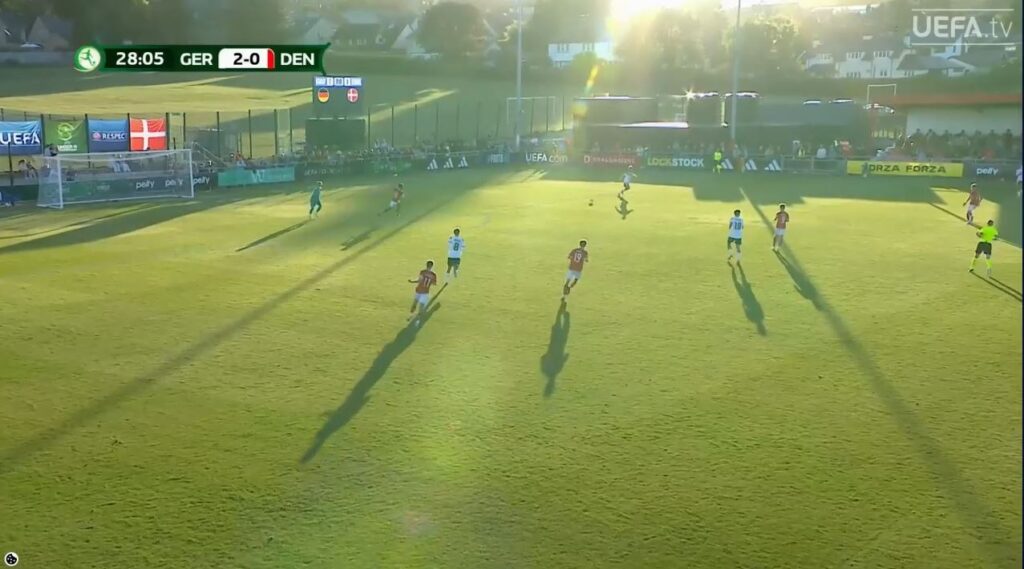
Out of possession, Germany applied an aggressive high press with a man-oriented marking approach. Both central midfielders closely marked Denmark’s midfielders, preventing them from building through the central areas and forcing play into wider zones. This coordinated pressing structure effectively disrupted Denmark’s build-up and limited their ability to progress the ball through midfield (see image below).
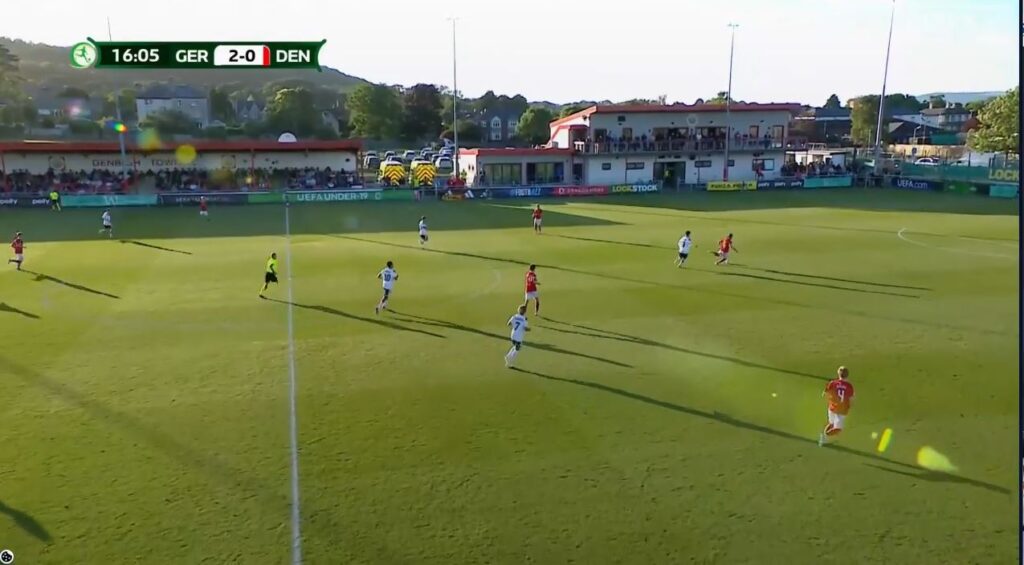
Germany took the lead after an intelligent movement by left winger Moritz Reimers, whose penetrating run into the penalty area forced the defender into a foul, earning a penalty. Francis Onyeka calmly converted from the spot to give Germany a 1–0 lead. Doubled their lead from a corner kick. The delivery into the penalty area created confusion in Denmark’s defence, resulting in an own goal as a Danish defender inadvertently turned the ball into his own net.
The third goal came from exploiting the space between Denmark’s midfield and defensive lines. A quick vertical attack through the central corridor bypassed Denmark’s midfield, allowing Otto Stange to receive the ball in space and finish clinically (see video below).
In the second half, Germany reduced the intensity of their play and lost control of the match. Denmark capitalized on this shift, creating several dangerous scoring opportunities. In the closing stages, Denmark came close to equalizing, but Germany managed to hold on and secure the victory.
Denmark, under Mads Lyng, lined up in a 3-4-3 formation, relying on quick attacking transitions and the pace of the front three to threaten Germany’s defensive line. They struggled to establish their build-up play in the first half due to Germany’s aggressive high press. Unable to progress through the central areas, they were often forced into direct play and relied primarily on counter-attacks to create offensive opportunities. Their first goal came from a penalty won after a quick counter-attack. (see image below).
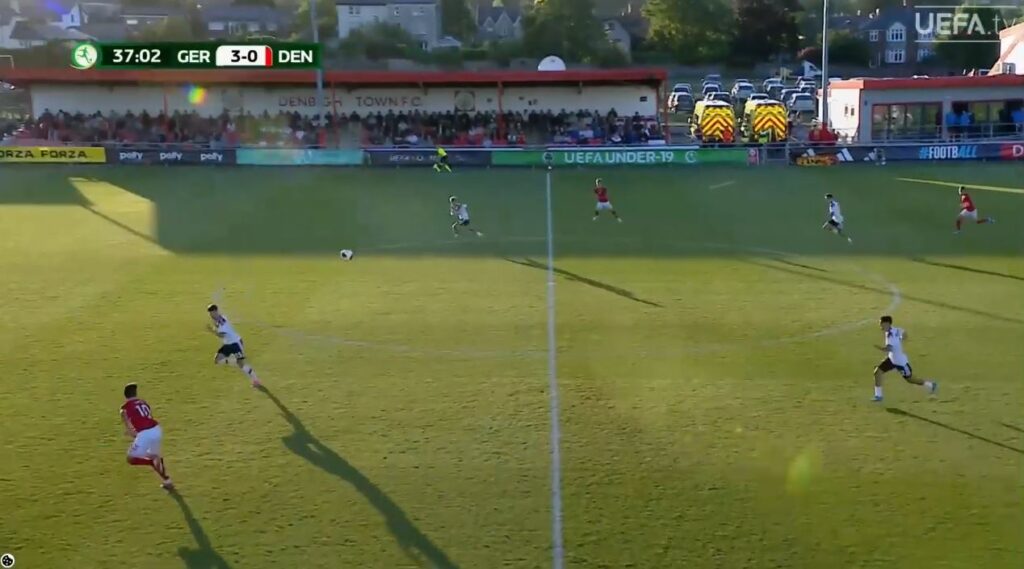
Out of possession, Denmark’s two central midfielders were often positioned too far apart, leaving significant space between the midfield and defensive lines. They also attempted to press too aggressively, which created gaps in the central midfield area. Germany exploited these spaces effectively, progressing through the middle and creating several dangerous attacking situations (see images below).
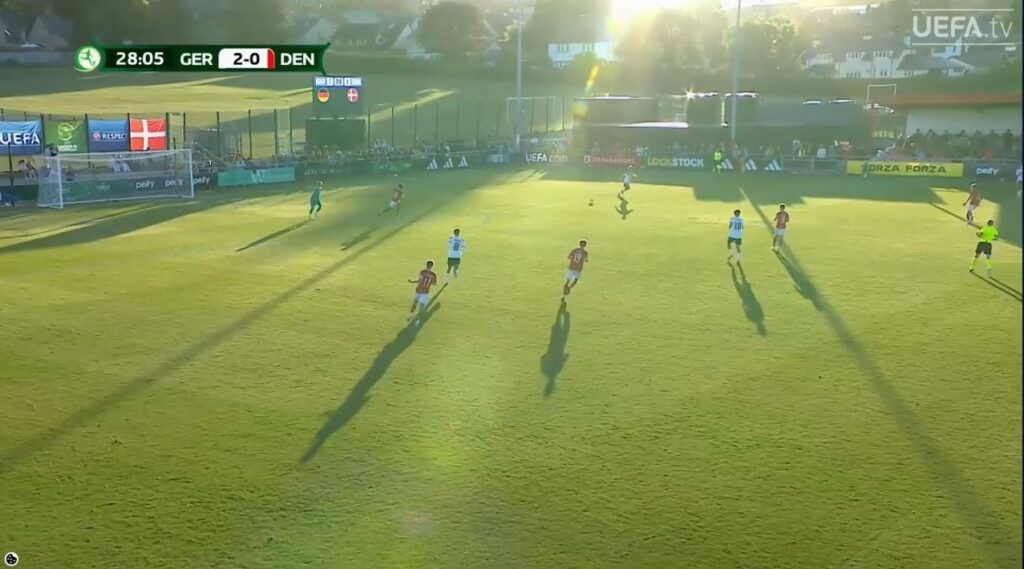
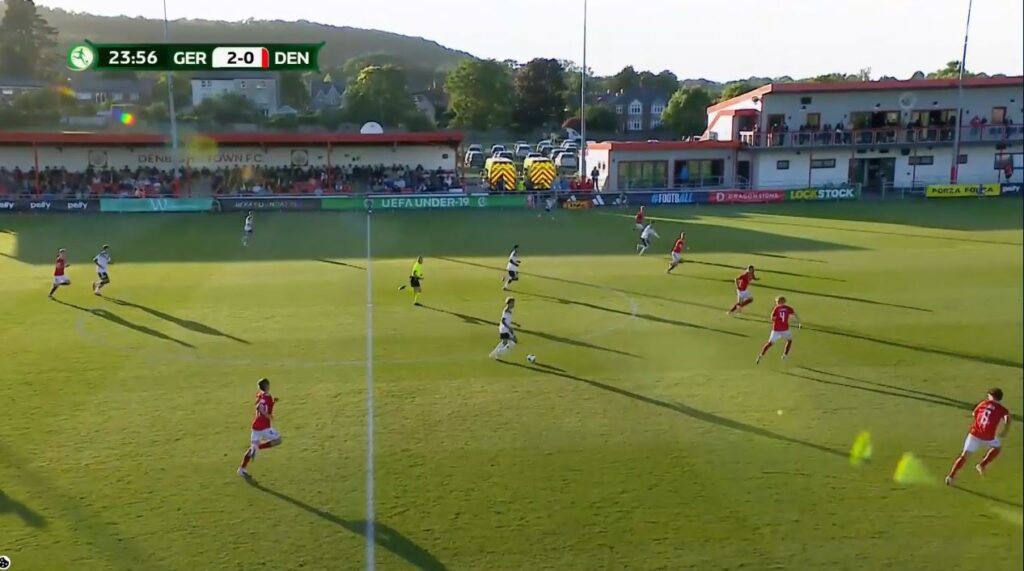
After the break, Denmark’s substitutions improved the team’s compactness in central areas. This allowed them to control the midfield more effectively, limit Germany’s transitions, and increase sustained attacking pressure, giving them a genuine opportunity to mount a comeback (see image below).
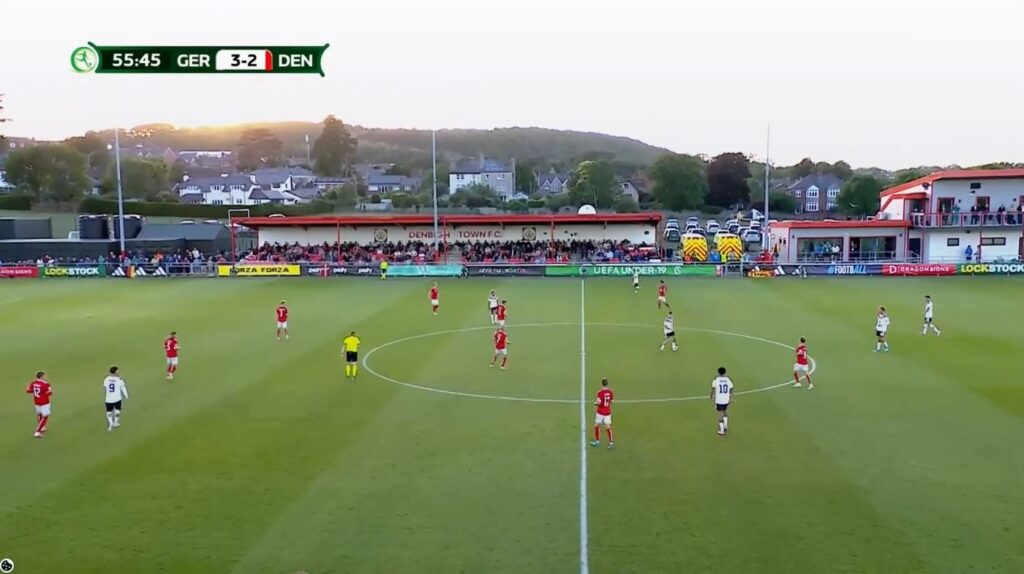
Here are the players who stood out in this match:
Olti Hyseni (Denmark / Sønderjyske), left winger born 2007.
Olti Hyseni is a dynamic inverted left winger who combines pace, direct dribbling, and intelligent movement in the final third. A product of Sønderjyske’s academy, he has established himself in the first team despite his young age and has also represented Denmark at the youth international level. He was Denmark’s most dangerous attacking player throughout the match. He made a significant offensive contribution, winning a penalty with an intelligent run during a counter-attack and converting it himself. He consistently demonstrated his pace, excellent 1v1 dribbling ability, and intelligent off-the-ball movement, causing problems for Germany’s defense whenever he had space to attack. His direct style and willingness to take on defenders made him Denmark’s primary attacking threat.
Rafael Pinto Pedrosa (Germany /Karlsruher SC), right back born 2007.
Rafael Pinto Pedrosa is an attack-minded modern full-back who combines athleticism with technical quality. A product of Karlsruher SC’s academy, he has progressed into the first team and has represented Germany at U19 level. His game is based on intensity, overlapping runs, and contributing in both phases of play. He displayed intelligent defensive positioning throughout the match. He read situations well, positioned himself effectively in 1v1 duels, and never hesitated to make decisive, well-timed tackles. In possession, he made a strong attacking contribution through constant overlapping runs, providing width and creating space for his teammates in advanced areas. His energy and timing allowed Germany to progress effectively down the right flank. He projects as a player capable of competing at the Bundesliga level if his tactical consistency and defensive decision-making continue to improve.
Moritz Reimers (Germany /Hamburger SV II), left winger born 2007.
Reimers possesses the profile of a modern inverted winger, combining pace, dribbling ability, and intelligent movement. His ability to create chances both for himself and his teammates makes him a promising attacking prospect. He demonstrated outstanding pace and explosive acceleration, allowing him to gain separation from defenders both in possession and with well-timed runs behind the back line. His speed was a key factor in Germany’s attacking threat throughout the match. He played a key role in the opening goal, using his acceleration and direct running to draw a foul inside the penalty area and win the penalty, which Germany converted.
Otto Stange (Germany /Hamburger SV), centre-forward born 2007.
Otto Stange has the profile of a modern target striker, combining physical strength, intelligent movement, and strong link-up play. His ability to occupy defenders while bringing teammates into the game makes him a valuable focal point in attack. Demonstrated remarkable composure and patience for a player of his age. He played with the maturity of a much more experienced striker, making intelligent decisions, timing his movements well, and remaining calm under pressure. Stange’s two-goal performance highlighted his clinical finishing ability. He showed composure in front of the goal and demonstrated the qualities of a natural goalscorer. His second goal was particularly impressive, as he struck a well-placed shot from outside the penalty area, beating the goalkeeper with accuracy rather than power. The finish reflected his excellent technique, confidence, and decision-making in the final third. His physical profile, tactical intelligence, and all-round centre-forward qualities suggest he has the potential to develop into a high-level striker.
You can check our offers here and reach out to us via our ‘Contact us’ page for fixed or flexible packages. If you like it please SUBSCRIBE to the blog and you will receive all future articles and news.
