

The short answer is no.
While the Colombia-Australia match was marred by referee decisions and sickness in the Socceroos camp, there were concerning signs for Australia 6 months before the World Cup.
Coaching
What was going on in the final third and in the box?
According to Fotmob, there was only 1 touch in the opposition box in the entire match made by the Randers centre forward Mohamed Touré. There were only 2 shots on goal, 1 on target from a direct left-footed free kick by Riley McGree. From this game, it would not have been possible to analyse how the Socceroos attacked in the final third and in the box.
In the middle third, the attack served up inconsistency and incomplete collective and individual ideas to generate different superiorities (qualitative, numerical, positional, etc.) and hardly got into the final third, let alone high xG chances, for example:
- A relative lack of quick combination play (required shorter distances between players)
- A 5v4 advantage on the last line with wingbacks gaining space but not enough 2v1 or 3v2 on the wing (despite Touré pinning the 2 centre backs)
- Runs behind the defence have different effects against man marking or zonal defending; not all runs resulted in goalscoring opportunities
- Touré had to hold up the ball against 2 centre-backs and failed to lay the ball off to No. 10s (with Boyle running in behind as another variation)
- Connor Metcalfe made channel runs behind the Colombian left back in wing rotation but lacked the pace to exploit the space
- Quick balls out to wingback Miller in different 1v1s situations (aerial, in space, in behind)
- McGree combined with Irvine and O’Neill with a midfield overload, picked up the ball in the pockets but there were limited threats in behind
- Irankunda struggled to impact the game (combining with teammates, back to goal vs running at the opposition defence)
- Without Jordy Bos or Craig Goodwin, there wasn’t much from the left flank
The counterattacks were gradual but non-threatening – good balls into running no.10s behind opposition midfield but the attack lacked numbers. When the wingbacks joined in, the ball was played out wide and the attack lost potency.
Reliance on set pieces and individual brilliance was not enough and Australia would need to find ways to create more set piece opportunities (including throw ins) and turnovers in the high press (this included inviting the opponent to build up). Overall, A significant issue from an analyst’s perspective.
Assurance of ideas
National Team managers usually come from a club background, where they have tested and established the right ideas that can be implemented in the team within a short timeframe.
Within the first 2 minutes of the game, the Socceroos tried to build up with GK and 3CBs in the 1st line. While adjusting the positioning to open up the passing lane to the 2nd line seemed like a good idea on paper, the outside centre-back could find himself boxed into a corner with the ball.
Mid-block
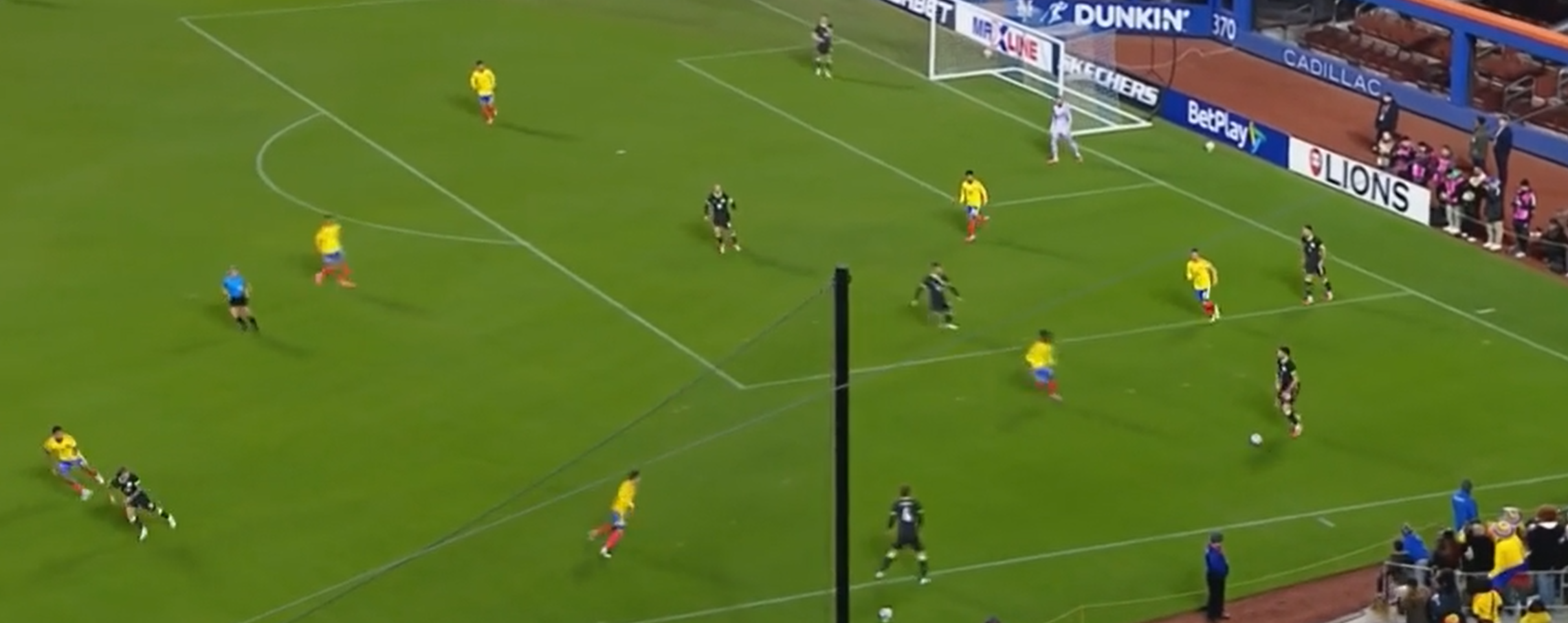
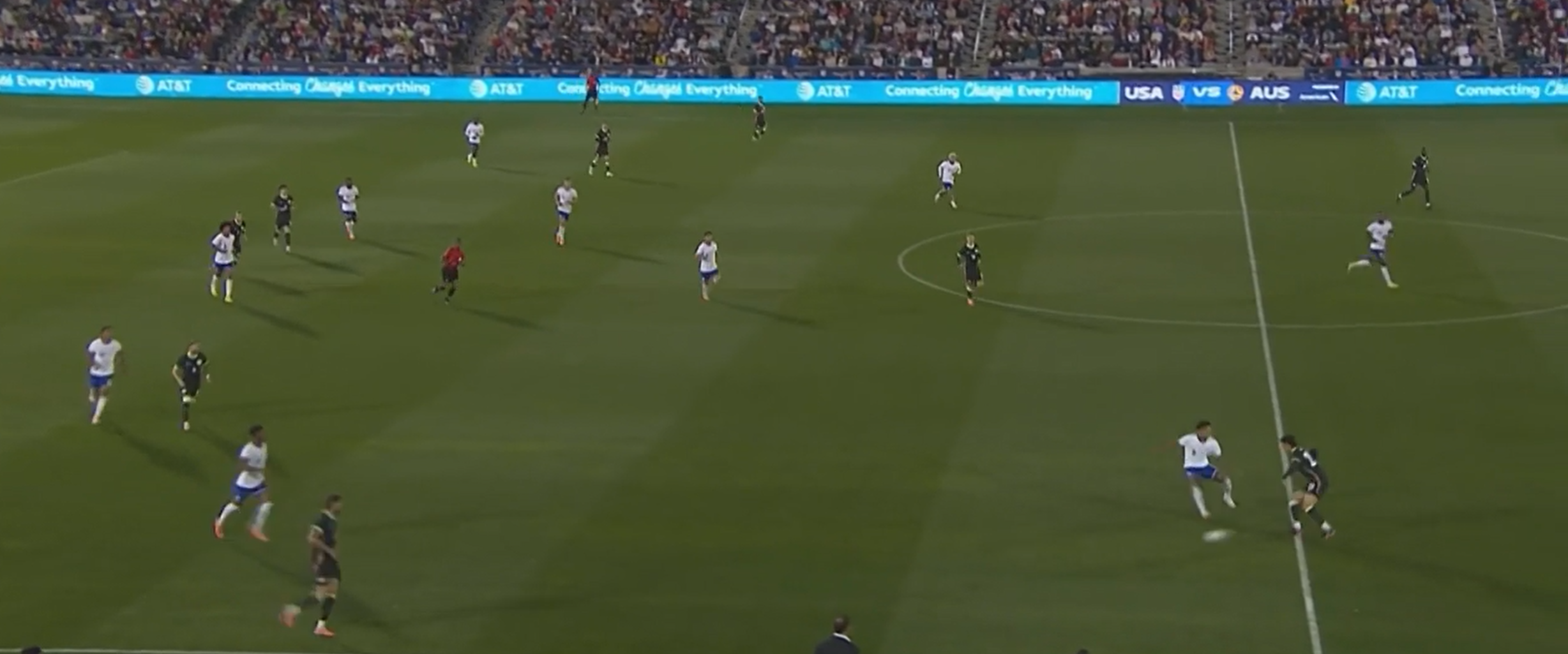
Australia spent the majority of the game defending in a compact 5-4-1 with pressing only on the wing with irregular execution. The pressing mechanism lacked the double press in this phase (where players pressured both the ball carrier and ball receiver – this was present during the high press) and did not force opponents into longer passes by increasing the vertical height (see the USA example below with winger and full back on the wing – using midfielders towards the wing could increase that distance and create a further possibility of side pressing, while it would be important for Australia not to expose the centre backs in a 1v1). Instead, only one player pressed on many occasions (the wingback pressed as high as possible at best). When the centre forward led the press with energy, it led to turnovers but sometimes exposed the centre-backs to 1v1s.
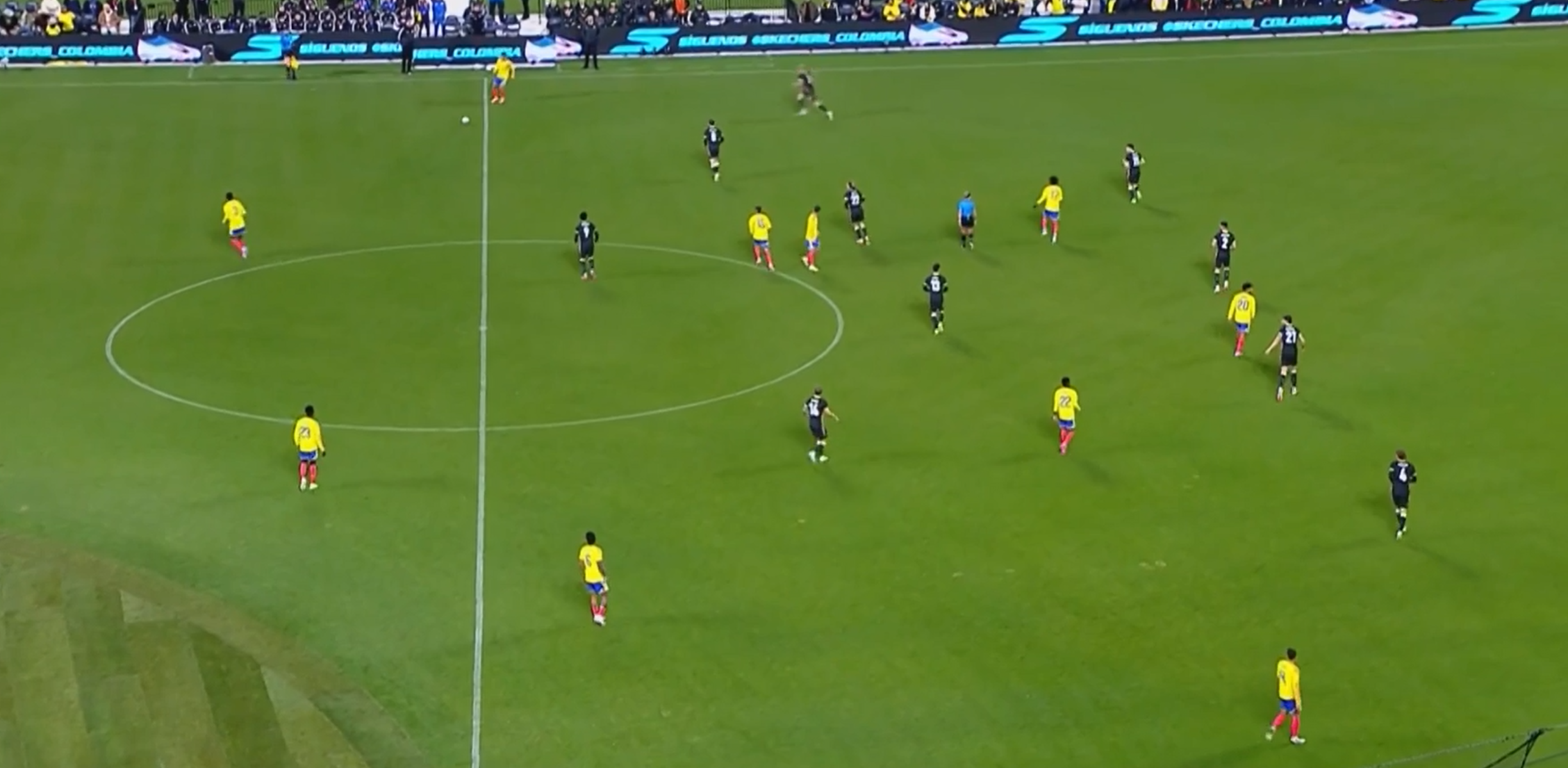
With the centre forward denying the pass to opposition midfielders, it was difficult to set pressing traps for Irvine and O’Neill to win the ball.
There were other contributing factors to increase the likelihood of winning the game other than the high positioning of the wingback, for example, Colombian centre backs’ time and space to dictate play, causing Australian players to eventually run out of steam later in the match, and possibly in the knockout stages of the World Cup.
Coaching and Analytics
Defensive corner
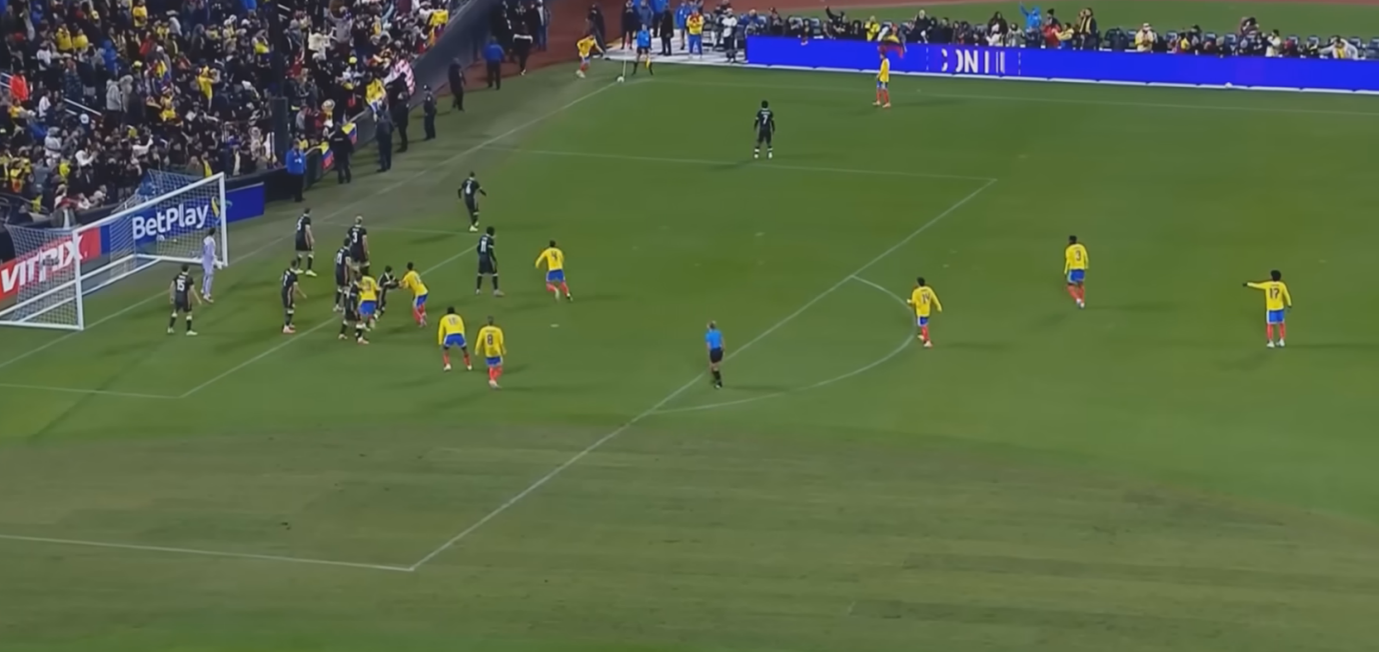
A statistically correct but practically incorrect execution.
In this corner, only 1 player in the first line was blocking the opposition run. Not blocking the run basically allowed the opponent a running jump versus a standing jump of the zonal defenders.
Like any corner set-ups, this allowed:
- An underload in the first line (3v5)
- Easy shot for the opponent with the 2nd ball / 2nd phase of the set piece
- Short corner routines
Reviewing the previous match
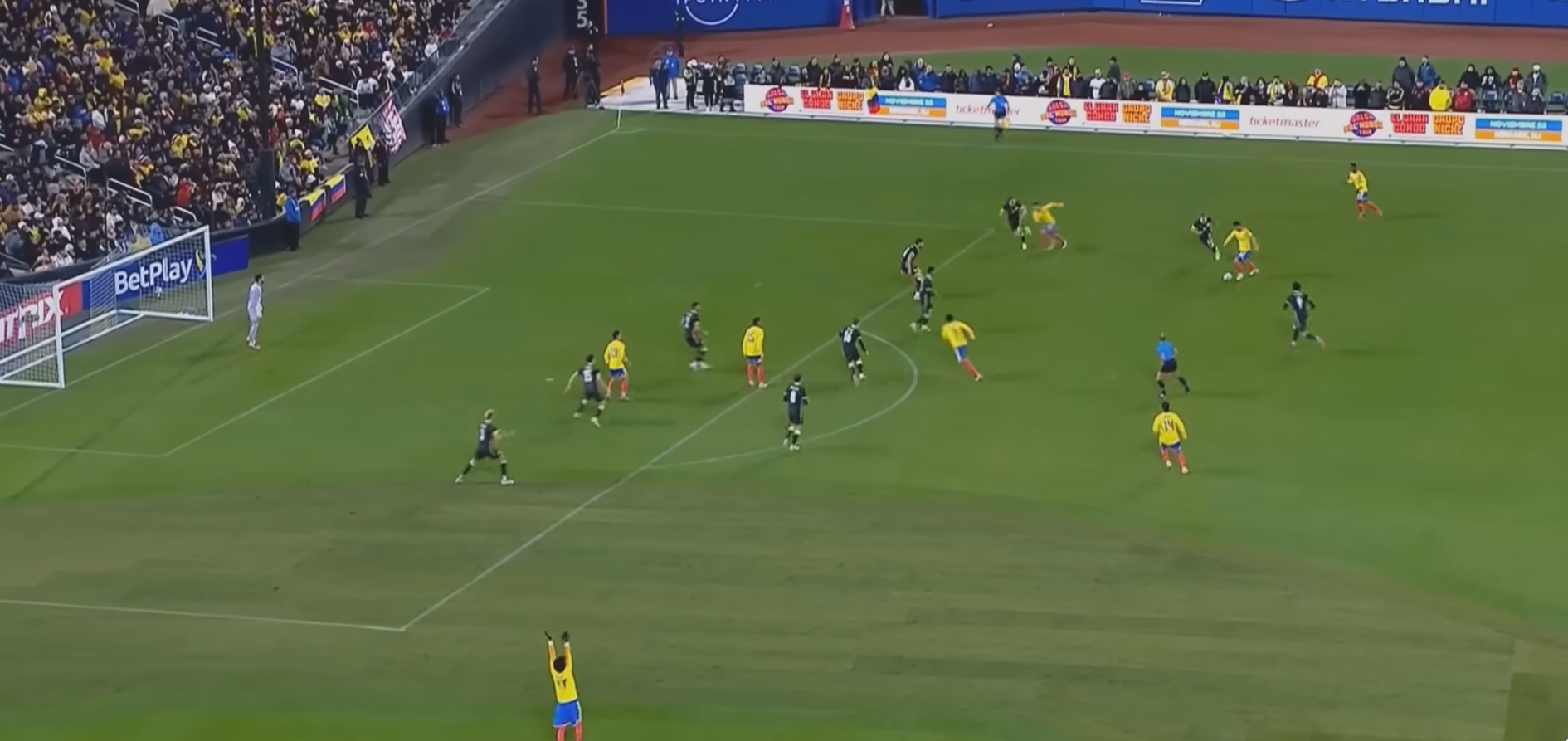
What was more alarming was the way the penalty for the 1st goal was conceded. It was a simple crossing pattern where the opposition winger played the ball back to a player in the half space and the ball was played in behind the defence. Australia fell for this in back-to-back games.
Against Venezuela, this pattern forced Patrick Beach into a fantastic save.
Against Colombia, the backline was again pushing up very high, knowing that the ball from the half space would be played over the top. Callum Elder conceded the penalty by pulling back the opponent.
This suggested a poor execution of the backline pushing up (running up to a set marker – to the top of the 18 yard box while the opponent in the half space was already on the ball and ready to play over the top) and a misinterpretation of the xG conceded (higher line meant no opposition touches in the box but with no marking and no defenders between the shot and GK, if the opponent took a touch in the box, the xG conceded would be too high a value).
Tournament Football
How would Australia amp up or slow down the tempo of the game like the Colombians did? How would Australia enforce or react to changes every 10-15 minutes? Australia would sit even deeper defending a lead but how would Australia try to gain an equaliser? The incessant push of the backline to the halfway line prior to the 2nd goal was not great execution. In the attacking sense, how would Australia gain distance up the field, who would cross the ball in (Ajdin Hrustic?), what would the set up be for the long ball and crosses for winning the 1st header and scoring or losing the 1st header and continuing to put pressure in? A heavy reliance on Mitch Duke to knock the ball down would not be suffice but Noah Botic‘s movement in the last line could lead to a goal.
And penalties. Fans would remember Australia’s hero, the Grey Wiggle Andrew Redmayne, in the 2022 World Cup. But if Louis Van Gaal was right about the goalkeeper’s arm span, Australia’s current goalkeeping options – Mathew Ryan (lost his place to Roberto Sánchez at Brighton for differences in reach and predicted growth), Paul Izzo and the inexperienced Patrick Beach – would invite strong shots into the bottom corner. Australians would hope that Ryan would regain his sharpness during his time at Lens and the third keeper could compete for this role in the penalty shootouts.
Stopping key players
Reviewing the Argentina vs Australia round of 16 World Cup, Australian players lost track of Messi in the 2nd phase of the defensive set piece and allowed him to score. How would the Australians stop these world class players again in 2026?
Players, Coaching, S&C
Use of the centre forward
Australia does not have a complete centre forward who can link play and also run in behind.
Against Colombia, the centre forward Mohamed Touré was asked to stay between the opposition centre-backs. Besides the very first attack where his pace troubled the centre-backs, some of his plays were called offside, his link-up play was not the strongest and he was not in the best position to win the balls into the channels.
This was extremely similar to Manchester City’s use of Erling Haaland in 24/25 to remain between the goal posts, however, City generated enough chances for their centre forward to score and realised that their attacks on the flanks were too predictable so they acquired Marmoush midseason to facilitate central attacks.
Developing right wingbacks
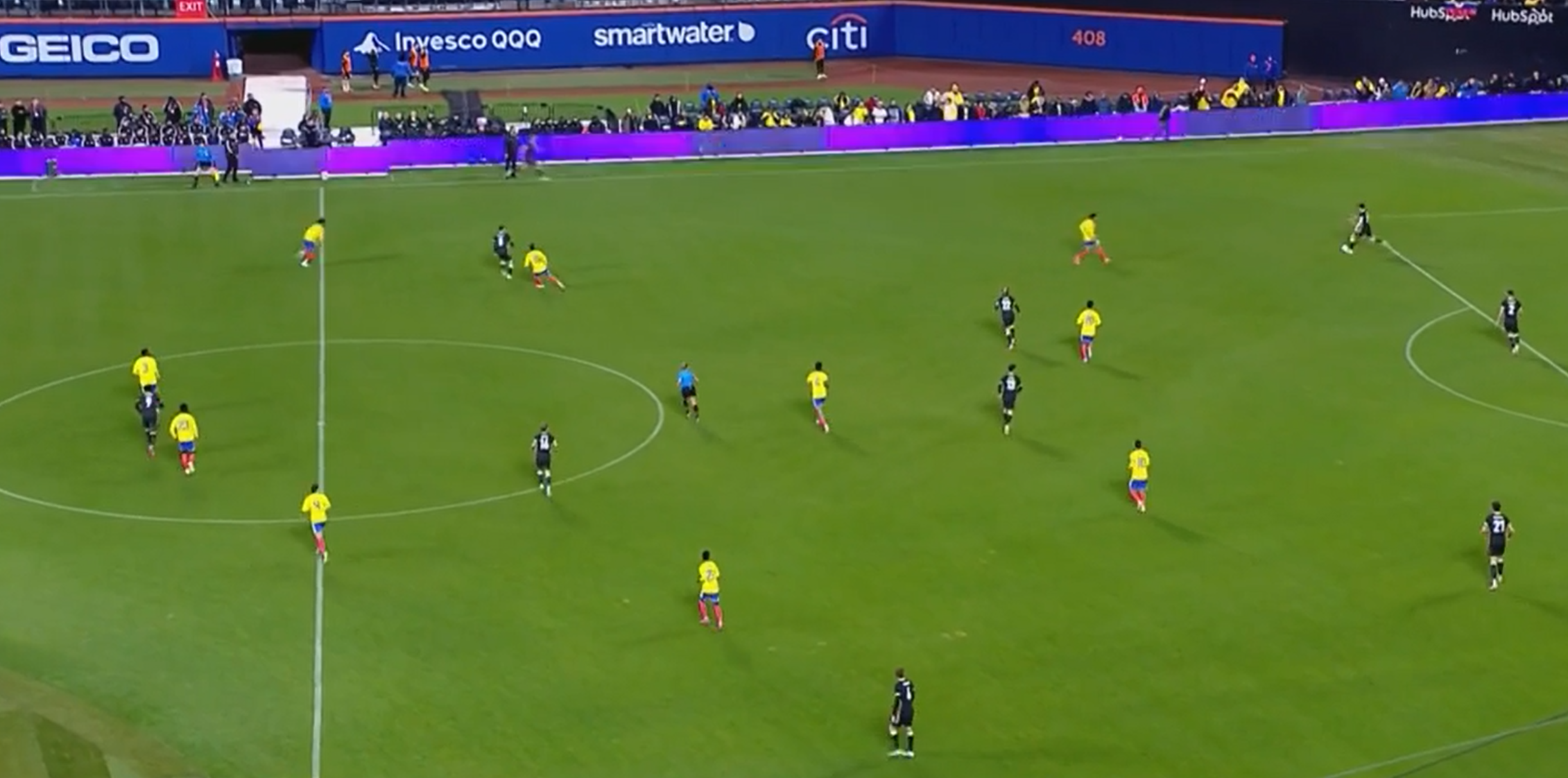
The Netherlands eventually found right-footed players who were willing to run in the form of Denzel Dumfries. For Australia, the competition for the right wing-back spot would be between Lewis Miller, Jason Geria, Jacob Italiano or Fran Karačić. In this Colombia match, Miller offered the long goal kick option on the right, however in the build up, where Australia used a 3-2-4-1, the 4 players were not instructed on when to come deep and generate +1 numerical superiority for the 3 CBs and 2 CMs to progress the ball and adjust their positioning when the opponent is pressing and moving forward (as opposed to standing on the spot), resulting in inconsistent plays on the wing.
Does Australia have a midfield passer?
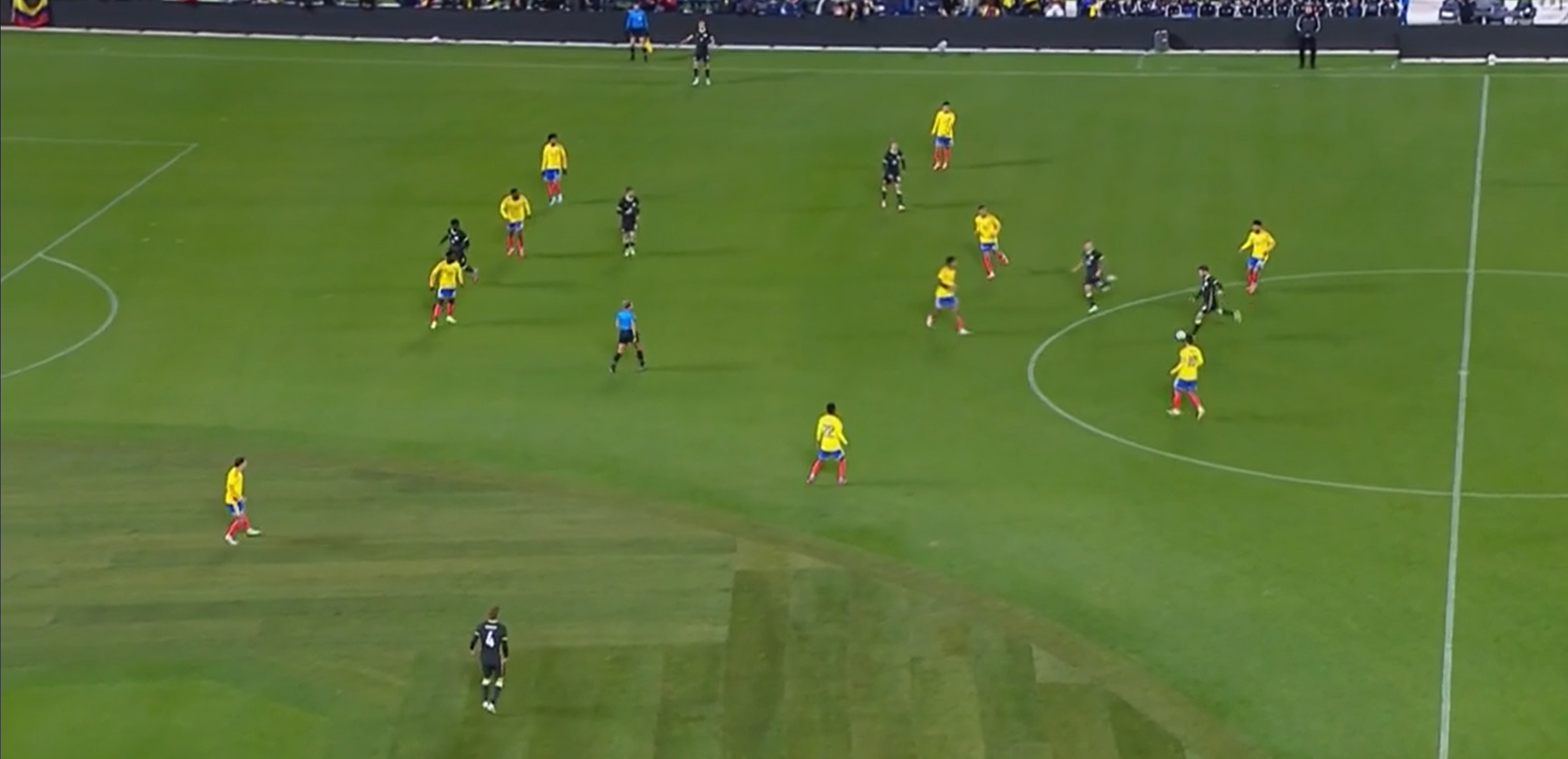
Long gone are the days of Australia’s own Aaron Mooy dictating play in midfield. The double pivot of Jackson Irvine and Aiden O’Neill provided defensive solidity and running power. In the Colombia match, Aiden O’Neill was tasked with spreading plays to the wing, however, his central positioning invited the press and he could not have taken an optimal long touch, which caused the long passes to be slightly inaccurate.
The image below also showed that once a winger drifted in field (McGree creating an overload in the middle with Irvine and O’Neill effectively), the team could only attack on the near side as there were very few positional structures in place on the far side.
The 3rd centre back
Australia would be forced to play with 3 centre-backs in the World Cup – it made sense that one more person meant more security at the back. Traditionally, the 3 centre-backs in the back 3 / back 5 are athletic, strong 1v1 defending players, with one stopper and two outside centre-backs who can carry the ball forward.
With a congested fixture, the back 3 can be rotated. The questions are:
Can defenders change directions sharply and generate power quickly? (Similarly, can Australian attackers make sharp turns and take powerful steps and generate good shots on goal?)
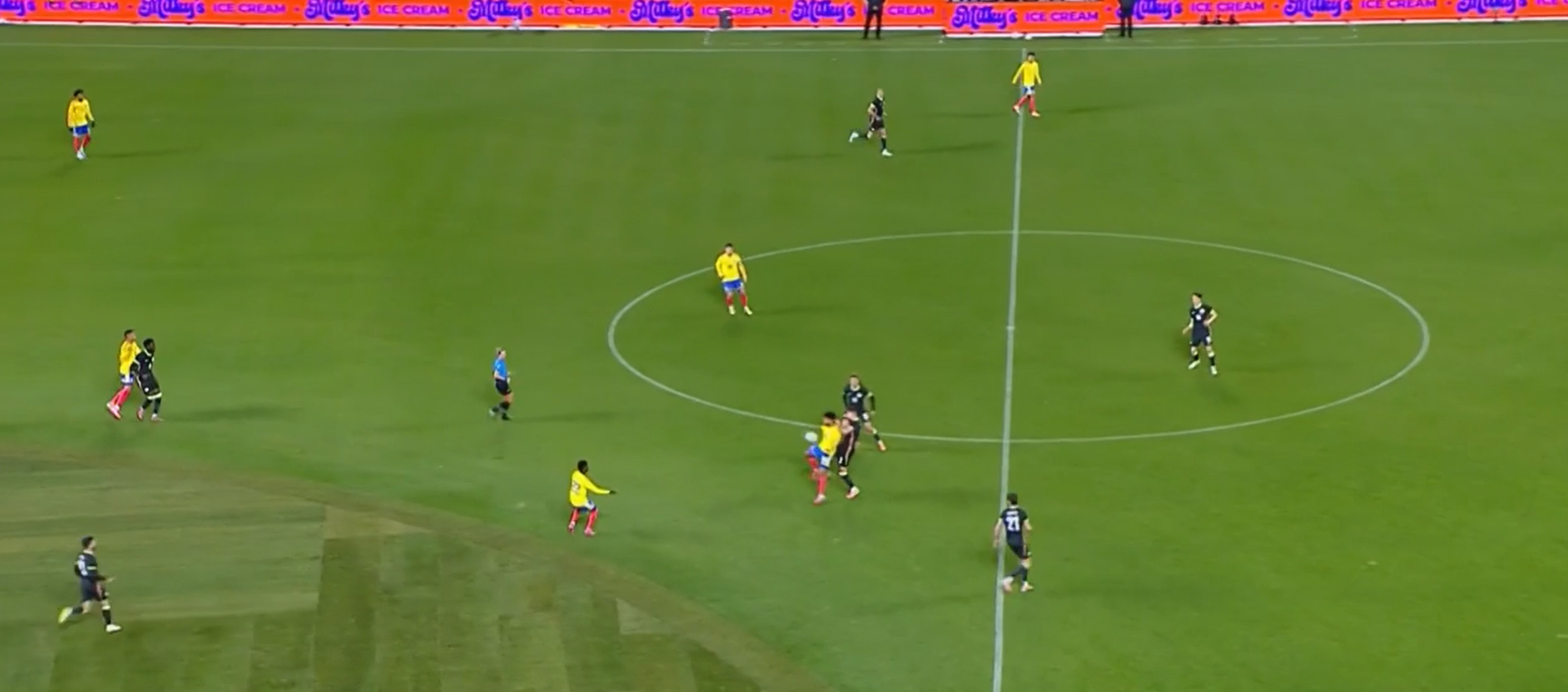
- In the 1v1 defending situation, Cameron Burgess’ slip against Haji Wright of USA and Kai Trewin was spun around by Luis Díaz
- Calum Elder’s foul for the penalty and Milos Deganak’s slow turn for the 2nd goal highlighted individual players’ ability to turn and defend and the need to pause when pushing the backline higher.
- Venezuela’s goal from a ball over the top and cross also highlighted the defender’s individual ability to recover, positionally and physically deal with the square pass or cut back in emergency defending.
Can the defenders play out of pressure?
- Kye Rowles gave away the ball twice in an unfamiliar left wingback position, while RCB Geria was also susceptible to being pressed in the past.
How would manager Tony Popovic deal with artificial transitions / high press and defensive transitions – not overly exposing the centre back in the 1v1, minimise the spaces between the lines and deal with opposition attackers at different heights?
Not all hope is lost
Australia finally has a squad where starting players in all positions play in competitive leagues and many bench players play at a good level.
5-4-1
Mathew Ryan (GK)
Lewis Miller
Harry Souttar
Alessandro Circati
Cameron Burgess
Jordy Bos
Conor Metcalfe
Jackson Irvine
Aidan O’Neill
Nestory Irankunda / Riley McGree
Mohamed Touré
Players on the bench include:
Paul Izzo (GK), Jacob Italiano, Hayden Matthews, Kye Rowles, Callum Elder, Aziz Behich, Jason Davidson, Max Balard, Patrick Yazbek, Denis Genreau, Ajdin Hrustic, Brandon Borrello, Mathew Leckie, Craig Goodwin, Mitch Duke, Noah Botic
Australia is very strong in attacking corners, with 6 starting players above 185cm (with substitute Mitch Duke there are 7 players).
Also, Australian players have high levels of stamina, with many players capable of covering huge amounts of ground e.g. Jackson Irvine easily covering 12km.
While there might be a world class squad in the next World Cup cycle, I just hope that Australia does not have to wait another 4 years to become a genuine World Cup contender.
by Jeffrey Chau, avid analyst from Australia
You can check our offers here and reach out to us via our ‘Contact us’ page for fixed or flexible packages. If you like it please SUBSCRIBE to the blog and you will receive all future articles and news.
